A kind of autobiography
September 8, 2026
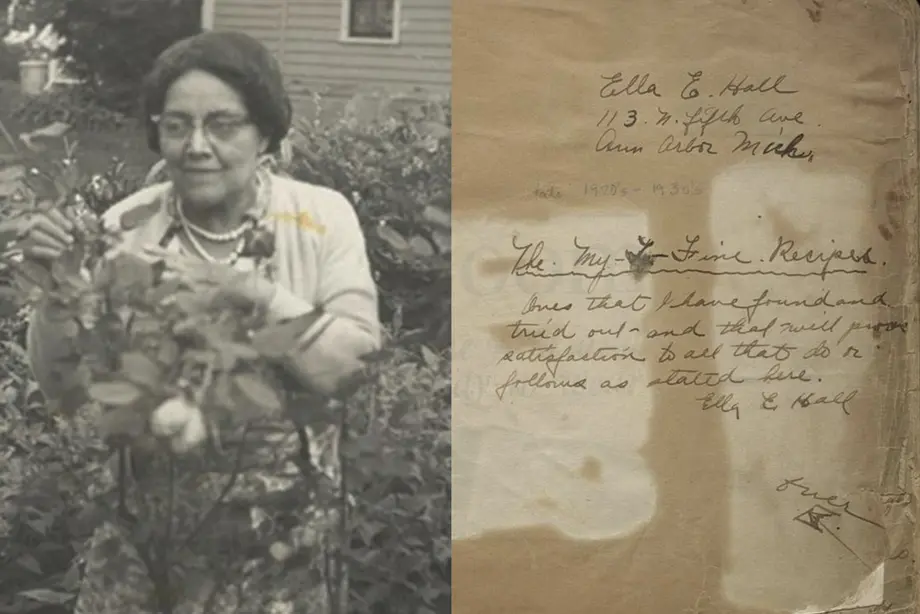
If Ella E. Hall (1892-1962) — a Black cook and landlord who lived and worked in Ann Arbor, Michigan for most of her life — ever wrote down her life story, it didn't make it into the recipe book she assembled between 1920 and 1939.
Now that collection, which is part of the U-M Library's Janice Bluestein Longone Culinary Archive, is being published for the first time, in a paperback edition and as a free e-book that everyone can download or read online. And despite the lack of biographical info, there's more than a glimpse into Hall's life and personality.
“The My-T-Fine Recipes," she wrote on its first page, by way of introduction to its future readers (is she expecting us?), "Ones that I have found and tried out–and that will [provide] satisfaction to all that do or follows as stated here."
"The Ella E. Hall Recipe Book" includes a facsimile of this notebook, images of the more than 50 recipes that Hall created, transcribed, or clipped from a variety of sources — friends, family, advertisements, food packages, radio, and more — for dishes including sour milk griddle cakes, Lady Baltimore cake, pepper hash, green tomatoes pickles, campfire pineapple ham, and beverages such as root beer, ginger ale, and even home-brewed beer, which might have been a Prohibition-era favorite.
It also offers some modern-day perspective in introductory essays.
Jessica Kenyatta Walker, assistant professor at U-M and scholar of African American history and foodways, describes the text as "a recipe collection and rolodex in one perspective, a collage in another, and ultimately a love letter to Ann Arbor’s African American community."
Ann Arbor author Susan Wineberg, who once lived in a house that had belonged to Hall and who donated the recipe book to the library, also offers some of her findings about Hall and the community she was part of. "[I]t's intriguing to imagine," she writes, after describing the emergence of zoning and restrictive covenants in the early twentieth century, "how Ella made her way in the liberal, yet racist, town of Ann Arbor, Michigan in the first half of the twentieth century. Her life and recipes may shed some light on this."
The curator's perspective
Juli McLoone, the Janice B. Longone Librarian for Culinary History, has tested and blogged about two of Hall's recipes, and the book includes a few that have been transcribed for easier reading and reference.
But the value of manuscript cookbooks like Hall's — the culinary archive has dozens of them, dating from the 17th-20th centuries — mostly isn't in their utility in our kitchens and dining tables, according to McLoone.
"I always tell people, about cookbooks in general, that they're not food diaries," she said. "We all have cookbooks that we've made maybe two recipes out of, right? Or New York Times recipes that we've saved, have never cooked, and probably never will." Our aspirations sometimes exceed our capacity, whether that's time or ingredients or motivation.
Hall’s recipe collecting involved more effort than bookmarking a webpage, and her introductory statement that these are “Ones that I have found and tried out” suggests that she did prepare these recipes. However, McLoone says that what makes this and other manuscript cookbooks most interesting is the way that their creators used recipe collecting as a way to craft aspirational identities. "You can think of it as historical dream work, almost," she says. (Though sometimes food stains point to the actual versus the aspirational.)
She cites the book "Writing with Scissors: American Scrapbooks from the Civil War to the Harlem Renaissance" by Ellen Gruber Garvey, a cultural history of an activity that arose "in a rapidly changing world of information overload," according to the jacket copy.
That book isn't about culinary scrapbooks in particular, but rather how people collect and organize things for their own use. And it leads McLoone to speculate about other areas of research that might be informed by manuscripts like Hall's.
"Someone could do a study of notebooks and stationary over time," she suggests, given that "people just go and get the composition book that's available, right?" An everyday resource that has the potential to reveal a little something about the material culture in a particular time and place.
"It's one piece you can use as a starting point that inspires more questions than it can answer," she says.
In other words, a great starting point for a curious scholar.